The third homeless person I ever met was Kyle.
It was 1982. I was two years out of college.
I was working at a month-long Christian discipleship camp for college students in the mountains west of Colorado Springs, Colo. Not far from Cripple Creek.
We spent some of our time talking to people in town. My group usually went to the town center – at the time a small park square, where a lot of drugs were dealt. Among us, we called it “The Pharmacy.”
You could watch kids with thick rolls of cash being passed to a guy who gave a nod to a guy on the other side of the park, etc.
Kyle wasn’t dealing, as he had no money. I talked to him behind a smoky sandwich grill and he told me he was homeless.
“What do you mean you are homeless?” I asked.
“I got no place to live,” he said.
“Well, where do you stay?”
“Me and some friends are staying in a vacant house right now… We broke in.” He answered my next question.
“What if you get caught?”
“Then I will stay in jail for a while, I guess.”
I have to admit, I was still naïve on the issue of homelessness. I had parents and grandparents and cousins and a girl friend and friends all over me, and none of them would let me drop to zero as far as living options. Didn't everybody have this?
I understand that, in the Orient, people who fall into the cracks for whatever reason are not expected to “insult” or “inconvenience” their family by seeking assistance for them. In their culture, this is not an acceptable option. Many of the homeless I have worked with have a similar situation – families and personal relationships are so broken up that no help is available from home. The situations are very different, but the outcome is the same.
Kyle was such a one. His “family” was made up of the strangers with which he shared a vacant house.
Kyle and I spent most of the afternoon together. I introduced him to some of the kids in my group. There was some level of trust built between Kyle and the group, such that I told him we were living at a lodge and some cabins in the mountains, and would he like to come with us and spend a few days.
Kyle said yes.
Continued tomorrow …
Friday, March 7, 2008


Thursday, March 6, 2008
Glimmer of Hope: VOA Replaces Director's Supervisor
Volunteers of America made a good move recently by putting someone else in charge of supervising the director of the homeless shelter.
The former COO, happily, is no longer overlooking the shelter, and is off overlooking other aspects of VOA’s many programs. Good luck to those poor devils.
Pam, the new supervisor of the shelter director, is a strong manager, good communicator and personable. I have previously hailed the work of the WySTAR substance abuse treatment program in my town, and, you should know that Pam has been (and continues to be) at the managerial helm of this program, which is successful and meaningful to a lot of people who have sought help to get away from alcohol or drug abuse.
So, this is a good thing. Yay.
Also, Pam is the only Volunteers of America officer who will give me the time of day. Everybody else is either pretending I don’t exist, or hoping I go away. Pam actually called today and wanted to talk AND listen.
I think I was heard. Good heavens, a new experience! A thank-you to Pam.
Wednesday, March 5, 2008
Lack of Supervision Gives Director Free Reign
You wouldn’t think that something like a shelter director’s position would be under-supervised. Unlikely as it is, in these litigious days when everyone is watching everyone else, the shelter director’s position in my town is practically unsupervised. The director had “weekly” meetings about two or three times a month with her supervisor. She told him stuff, and that was it. His understanding of the shelter was based only on the information she gave him, rendering him completely unaware of problems, the like of which I have made record on this blog.
And, by the way, if anyone finds a word untrue on this site, let me know and I will remove it immediately.
The director’s supervisor, then known as the Chief of Operations, or Chief Operations Officer, or something else that spells coo, was onsite at the shelter only three times in 2007, by my own count – once to fire me, once to get his picture taken with the donation of a dead animal, and once possibly to be seen being there (I don’t know).
Plainly, the man was in no wise supervising and hadn’t a clue about the shelter’s operation. He had seen a few numbers on columns, though.
I think you have probably seen this kind of “administration,” where someone is left in charge, and as long as the place doesn’t burn down, it is assumed that all is well.
All is not well, as I pointed out to my supervisor, her supervisor, the board and CEO, and the national office of the Volunteers of America. Link by link this was my chain of command. Each time the response was either denial or silence … or deftless attacks on me.
I don’t personally need any attention. I like the life of a quiet, shy person. However, I am duty-bound by my faith to draw attention to injustice foisted upon vulnerable souls; to the sanctity of life and basic human dignity being toyed with by people who say they like to “help,” when they mean they like to “control.”
Tuesday, March 4, 2008
'Homeless' and 'Hopeless' Only One Letter Apart
Hope is a casualty of homelessness.
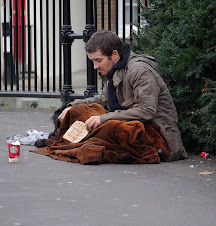
The photograph to the right, under the word “Broken” is worth the 1,000-plus words it would take to describe what the downcast, ashamed, lost look that this young man expresses with his face and body language.
Yet, in the face of homelessness, all is not lost. Hope does not have to throw itself under a bus. Jesus Himself was homeless for a time, and in His experience is the implicit statement that He knows the ills and the hollowness and the pain of belonging nowhere and to no one, except His Father in Heaven.
I know a man who lost his home in the Katrina storm. He told me, “Once I got through that, I figured I could get through anything.”
Then, his wife died of cancer. Again, “Once I got through that, I figured I could get through anything.”
Then, with everything he had left in a van, while driving in Florida, he was in an accident and the van caught fire.
He stood on the roadside with nothing but whatever was in his pants pockets.
“Now that I have gone through that, I can go through anything,” he said.
He had the faith and the character to embrace something larger than life as an anchor.
He had, and still has, the understanding of God’s presence, which supercedes all losses. With this, he was able to keep a hold on hope. He could have given up, but he didn’t, because he was aware of something, or Someone, larger than all his misfortune.
It is often true that someone else must come along and provide hope for the one who cannot muster it. Each of us has enough hope in us to share. No hoarding, now!
Monday, March 3, 2008
The Second Homeless Person I Ever Met
The second homeless person I ever met was in Chicago in the summer of 1980.
The numbers seem small and my recollection good because I grew up in a small Wyoming town of no more than 2,000 people. If you were homeless in Greybull, you would have stuck out like paisley on stripes. Everybody had a place to stay, except for the occasional hobo, who would drift into town from the railroad tracks that defined the west edge of town, and maybe knock on a few doors for something to eat or some spending money.
Meeting someone with nothing to their name was a rarity for my time and place.
So here I was on Evans Avenue in Chicago at age 23. I was visiting a friend who worked during the day, so I did a lot of exploring along Evans, which was just a couple of blocks from my buddy’s apartment.
As a small-town kid, I enjoyed the thrum of the vast numbers of people all around me, and the persistence of normalcy I noticed along Evans. I remember the “Major Café,” with the “r” missing on the sign. I called it the “Majo” in my journal. There were small shops and people everywhere.
At one point, as I was walking along on my fourth or fifth day there, a shirtless thin black man with some gray in his beard walked toward me from the opposite direction. It would have been natural for us to pass.
He stepped gradually into my “lane” and we stopped, facing one another on the sidewalk; me feeling nothing other than curious.
“Hello sir,” he said to me. “You wouldn’t have any cash you could spare, would you? I am in a bad way.”
As a reflex I stuck my thumb in my hip pocket where my wallet was, but then realized I had no cash.
“I’m sorry,” I said. “I only have traveler’s checks right now.” This was the truth.
“Alright,” the man said. “At least you talked to me.”
He gave me a quick embrace and said, “Thank you, anyway.”
I have never forgotten how deeply those words descended into my heart: “At least you talked to me.”
Hungry for food, but starving for kindness.
Sunday, March 2, 2008
Once upon a time there was this homeless shelter, ruled by an unkind queen
’T is a cruelty
To load a falling man.
The Bard of Avon’s observation can be cut and pasted into the crux of my concern about the poor treatment of the vulnerable at my town’s homeless shelter.
I grew up with fables about cruel kings and their unfortunate people; a merciless step-mother and two mean-spirited step-sisters; a malicious being forcing a princess to guess his name or else … and many more.
Later, reading some of the works of Roald Dahl to my older daughter, I once again ran into fictional persons with an affinity for cruelty who were put in charge of others – most notoriously, Miss Trunchbull, the school-master in Matilda, who behaved despicably toward children and kindly teachers, whom she considered weak.
It is, as Shakepeare points out, cruel to add misery to a person in dire straits (the circumstances, not the band). It is sad and wrong-headed to bring anguish to people while telling them you are only trying to help, and that you know what is best for them.
The Sheridan Community Homeless Shelter would make a great fictional tale, but, is instead a sad reality.
Saturday, March 1, 2008
All She Wanted Was For His Things To Help Others
When I moved to Sheridan in 1986, he was one of the first people I met who made me feel welcome.
He was a retired Army colonel; a gentle, deeply devotional man.
He always had a cheerful, thoughtful comment. We often talked of faith.
He wore out dozens of rosaries while praying in church. When I joined in my 40s, he helped sponsor me, and he gave me a big black rosary as a welcoming gift.
I knew him for almost 20 years before he died three years ago, at age 89.
It took his wife two years to summon the courage to depart with some of his things.
She called me one evening and asked what would happen to her husband’s clothes if she donated them to the shelter. I told her it was my understanding that they would be given to people who needed them.
“As long as they help someone else,” she said. “I think he would have liked that.”
She asked me to come by and pick up the things she had made ready.
She would not let anything go that was damaged in any way. I filled up my car with boxes and armfuls of jackets, shirts, pants, shoes, hats and coats.
Some of these I recognized as his.
I took these to the Sheridan Community Shelter where I worked.
As it happened, this was the same time that the inadequate storage for donations was in serious need of organization. We were, the director decided, too full. As a result the donations in storage were trucked to the landfill in at least four huge loads.
I thought about his wife, and her hopes that his things would do someone else some good. We failed her, big time.
Thoughtful donations were shrugged off, much like many of the people who stop at the shelter for help. They, too, are discarded.
Which is easier to throw away? A jacket or a person. At this shelter, both are treated the same.
Subscribe to:
Posts (Atom)