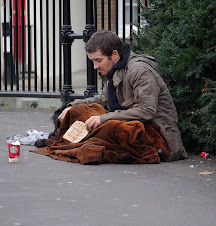
This is a great article about a guy in Atlanta who is doing what he can for the homeless in his community.
Notice how he talks about the homeless, about blaming, and about dignity.
If he saw our shelter, I don’t whether he would laugh or cry. Well, probably cry:
http://gtalumni.org/StayInformed/magazine/win98/homeless.html
Friday, February 8, 2008
Wednesday, February 6, 2008
Shelter Holds Your Medications Hostage
I am soon to be 51. I never thought I would make it to this number. It is darn near exhausting being 17 three times.
Each year, on Ash Wednesday, the priest has an increasingly vaster canvas on which to draw the ashen cross above my eyeballs when I present my ever-baldening head for marking. I hardly need a reminder that I came from dust, and to dust I will return. (Where is Kansas when you need them?) My feet and my knees and my hips and my back are always singing their painful refrain.
As I get older, I am adding prescriptions to my medicine cabinet at the rate of about one per year. I am up to five, and soon will have to move my stuff from the cabinet to the cedar chest or something.
Many zillions of us are taking medication – for pain, for moods, for a sagging endocrine system, for blood pressure, for fungus, for tumor shrinkage – name the part of the body, and there is an industry our there to support it, correct it, enlarge it or tenderize it.
Our homeless brethren are no different. Many come to the shelters with a bag of prescriptions. One guy who came to the Sheridan Community Homeless Shelter had emptied all of his prescriptions into a one-gallon freezer bag. He must have had 2,000 pills in there, of 20 or 30 varieties, from psychotropics to vitamins.
The question of one’s personal prescription use, as you might imagine, is a large one in the context in a homeless shelter – in a worthy one, much less the Sheridan one.
As you might guess from the tenor of previous posts, the dictator at the Sheridan shelter uses strict controls to limit access to medication. Not only is it highly unlikely that anyone else would get to your medications, you yourself could have a difficult time as well.
Imagine being accused of drug abuse because you want to take a pill an hour early so you can make it to town for a job interview. (One of the shelter staff claims near psychic powers in 'knowing' who has a drug problem. Turns out, his answer is 'everybody.') Imagine your head throbbing for two hours after you asked for access to your migraine-strength Tylenol because the staff and director are too busy.
The last time anyone kept you waiting two hours for your as-needed (PRN) pain medication, I will bet you were angry as well as hurting. Unfortunately, the shelter dictator not only limits access to a homeless person’s own medication, but she often counsels people on what they should be taking, or when they should be taking it. This direct control and major intrusion on one’s privacy and one’s condition is yet another way that the resident is lorded over and depersonalized by a megalomaniac behind a desk.
“If they don’t like it,” she says, “they can leave.”
Many have.
Tuesday, February 5, 2008
'Welcome' is a funny word at this homeless shelter
About one-third of the people who seek assistance at the Sheridan Community Homeless Shelter are either later kicked out, or leave on their own because they can’t endure the contortions of living in the tilted chicken-wire hutch that is the director’s world.
Not only is the revolving door at the shelter spinning fast enough to affect the weather, those who are whisked away by the breath of the dictator’s nostrils are placed on an ever-thickening stack of pages known as the dreaded “Not-Welcome-Back List.”
It was, in fact, my job last year to dream up a written policy on this list. For nine years the shelter had been operated (yes, by the same director) without a set policy on how one got one’s name on “The List.”
Worthy shelters have a policy backed with a process by which an applicant can request a review. Worthy shelters let their resident know that this process exists.
As you might guess, policy or not, names are added to the list based on the whims and distortions of the director. If you are difficult to work with, disorganized, unsociable, or if she missed lunch that day, you are sure to go on “The List.”
To be included on this list is the director’s way of saying, “We Will Not Help You,” unless you consider a referral to the next shelter 100 miles down the road as “help.”
She has even talked about veterans in the contractual program with the VA, saying, “If he leaves for any reason, he won’t be welcome back.”
I know what you are asking. The answer is, “Because.” That’s how the “Not-Welcome-Back List” policy works.
Just last month, a Sheridan woman was found to be camping out by Interstate 90, and a certain amount of public brouhaha was raised.
In the newspaper, she made it clear that she could not use the Sheridan Homeless Shelter as a resource because “five years ago I got kicked out of there for using the ‘F’ word.”
Incidentally, in the written policy, there is no reference to the use of the “F” word, which I presume to be “Forbidden.”
This woman knew she was on “The List.” For five years.
This comment from the woman made the shelter look bad, so there was a scurry within Volunteers of America to nip the appearance of poor service in the bud, even though t’was true.
“Our image!” came the howl from local headquarters. “Our sacred freaking image!”
Much ado occurred in the office, and a lot of coffee was likely spilled in the effort of VOA officials to lunge at whatever was close by to use as covering for their asses, which were, to some extent, hanging out.
“Oh my,” cried the director in the newspaper. People can always come back to the shelter and, she said, if they have made some changes in their lives, they can come back. “We love to help people.”
Two problems: First, not a single individual in 2007 who was asked to leave, was told they could check back later to revisit their “status” on “The List.” Second, the shelter stance on the homeless is, “We love to help lovable people. Others, not so much.”
Monday, February 4, 2008
Problem smaller, responsibility larger in rural America
Comparatively speaking, my town doesn’t have as big of a homeless problem as some of the larger communities within an afternoon’s drive from here: Billings, Rapid City, Casper and Cheyenne.
Certainly, we in rural America do not come even close to seeing the numbers of homeless in metropolitan areas – the makeshift homeless “camps” on the fringes of the cities; the alleys, bridges, the curbs, the parks, the hallways all populated with people who have no other place to go.
You have to be wary of statistics when talking about homelessness, because a nose count is impossible. One source estimates that 750,000 people per night are homeless in America, and also estimates that 9 percent of the homeless are in rural areas.
That is 67,500 people. This number is just over 12,000 more people than are estimated to live in Wyoming’s largest “city”: 55,314.
Statistics tend to make the issue of homelessness unwieldy and impersonal.
If someone in your immediate family is homeless or becomes homeless, this personalizes the issue fairly quickly. It is a big deal.
In many families, the family itself comes to the rescue and brings its beloved member back into safety and stability.
Sad to say that I have spoken with dozens of homeless people who have told me that they have family in another town or another state – sometimes even in Sheridan – but staying with them is not an option. I guess it has been a long time since ‘Ozzie and Harriet’ was on TV.
It is, however, true that the basic social units that we find ourselves a part of, can and should adequately serve, sustain and assist the homeless persons we find within those units. For example, a neighborhood. A rural neighborhood might have one or none homeless person – a guy who sleeps at the park, or holds a sign on the street.
If it is my neighborhood, I share some kind of responsibility for answering to this need.
If it is my community, the number of homeless person will go up, and so does the number of community members who share some kind of responsibility for answering to these needs.
From here, of course, we can go to county, district, region in the state, the state itself, and the state’s region in the nation, and the nation. As the perspective broadens, my individual responsibility shrinks. In rural America, the homeless are not necessarily more evident, but our individual responsibility is much greater because there are fewer of us.
Rural communities do have their own-sized homelessness to resolve. We are going to have smaller works, making huge differences in the lives of our relative few homeless and under-sheltered people. In so doing, we heal the hearts of people. What greater work is there?
Sunday, February 3, 2008
Faith In Others Is A Casualty Of Homelessness
I talked to a guy in front of the Edwards Hotel the other day. I knew him from my shelter-working days. I hadn’t seen him in a while.
I was looking for another homeless man who had been kicked out of the Sheridan Community Homeless Shelter (like so many others) several months ago. He is often walking along the main drags of Sheridan. Since he got kicked out, he has been living in a room about the size of two double beds. I walked up the narrow claustrophobic staircase and paced up and down the hallway a couple of times, hoping to spot the guy.
No luck.
I came downstairs and out on the street in front was this other guy – a veteran, a musician, an alcoholic, a thinker.
We surprised one another. Neither of us expecting to see the other, and especially not in front of the pawn shop on the ground floor of the Edwards Hotel.
“I was hoping to bump into you sometime,” I said.
“Why?” he asked.
“I just wanted to touch base and see how you are doing.”
“Really?” he said. “What’s your agenda. I mean, are you just a nice guy, or are you doing this for some reason.”
I am still getting used to the natural mistrust that seems to be more apparent among the homeless. He had had so many things stolen from him, so many fights on the highways and by-ways, so many promises not kept, so many assurances not followed through.
I smiled and looked at him through the corner of my eyes.
“I am just a nice guy,” I said. “C’mon. You knew that.”
It is hard to trust yourself into the care of another, especially when care has had a history with you of halting starts and frequent sputters. Comprehensive care and an unbroken continuum of care are still at the dreaming stages, but I am convinced if we keep paddling our little boats, we may one day reach shores only heretofore dreamed of. Feather those oars, lads, lest we shorten our carry! Nautical talk, that.
Saturday, February 2, 2008
No affirmation here, just down words
Legal trouble pushed him to the Sheridan Community Homeless Shelter.
He had been placed on probation for a non-violent crime, and his probation officer had given the young man specific and limited latitude on where and with whom he could live.
Housing was tight in Sheridan then, as it is now.
He could not have a roommate, and he had to have a place with a landline phone. He had to maintain employment and pay regularly on his fines. He could not leave the county, nor have his probation transferred to his home county in another state.
He was required to make three job applications per day until he got a job. I advised him to take no less than $10 per hour, so he could pay fines more quickly and save for the initial expenses of renting an apartment.
He was never trouble at the shelter. He did his chores, met with me to make sure he was on track, and ignored a staff member who often taunted him by saying, “What are you doing here?” or, “Why are you still here?”
This staff told me he believed the young man was a drug user, and would come to nothing during his stay at the shelter. I, too, ignored the staff member.
Of all the things that a homeless person needs when they get up enough courage to enter a shelter is personal affirmation – someone to believe in them – someone to believe in them for them. Of all the needs ignored most at the Volunteers of America Sheridan Community Homeless Shelter, it is this need of affirmation. One of the staff and the director are quick with criticism and belittlement and bullying – the exact opposite of what one expect from a supposed Christian-based work.
It is in the “Rule of St. Benedict” (the founder of the Benedictine monastic order) that each stranger is to be treated as though he were Christ in disguise. At the shelter, each stranger is treated as a suspect, a sore festering with dereliction, a problem, a threat and a pest. The Rule of St. Benedict is not spoken here.
The young man stayed a long time with us, given his constricted situation. Eventually I suggested he ask his PO if he could have an approved roommate, and said I would attest to his good behavior, hard work and pleasant character.
He just barely made it out of the shelter before he was to be kicked out. The director was very concerned that we had helped this guy out. Apparently, she doesn’t like to see people succeed outside of her control.
Friday, February 1, 2008
Shelter's status quo hurts good people
He had become a little disconnected from life.
He came to the shelter, alone, with a vague idea that he was going to head east and make amends with his parents and siblings.
He was just on the other side of middle age.
Once at the Sheridan Community Homeless Shelter, as sometimes happens, he decided to try to drive a stake in the dirt and call Sheridan his home.
This meant finding a job.
He had a technical background in his work history, and wanted to pursue jobs specific to his knowledge and abilities. Jobs, at this point, were hanging on trees in Sheridan. Employers were falling on the feet of anyone who would come in and apply for work.
The process of applying and acquiring a technical job would take a little longer than running downtown and nabbing employment in the food service, construction or sales industries. We both knew this.
He started the application process and got a lengthy spot job pulling weeds in a field for a nice lady who paid $100 per day, which, good Lord, was more than I was making at the shelter.
Meantime, a staff member bet me that this guy was a “shelter hopper,” and that he would not amount to anything. I begged to differ.
The shelter director decided, on a whim, that the shelter would no longer “support” spot jobs. She was bound and determined to push this man to get a “real” job.
I defended his choices, believing that in time he would get a good job in his technical field, once the application and waiting process had run its course.
The staff member one day announced to the man that he had “three days to find a job, or you are outta here.”
They especially like saying “outta here” at this shelter.
The man came immediately to my office, and said, “Tim, what am I going to do.”
“You are going to get a great job in your field,” I said. “I am going to tell so-and-so to stop mindlessly threatening people.”
Honestly, I don’t think I even slowed him down.
The man got a great job in his field and a place to live. Sheridan is his home.
The status quo at the shelter would have bumped him down the road.
There is a vast difference between making a person someone else’s problem, and working on solutions for that person. The shelter director and some of her staff must have missed school that day.


Subscribe to:
Posts (Atom)